Luoyang
So, what's there to do in Luoyang?
Luoyang lies halfway between a fully modern city like Xi’an and a somewhat more provincial one, and is fortunate enough to be home to truly fascinating sites such as the Longmen Grottoes and, a little further away, the Shaolin Monastery.
When it comes to finding a place to stay, what we might call the city center is bordered to the north by the old train station (which the bullet trains do NOT pass through) and, a little further south, by a huge avenue that runs from east to west called Zhongzou Rd. On this avenue, you’ll find “Western-style” stores, supermarkets, and even a Starbucks; as a bonus, the bus station is right next to the train station, and many of the city buses you’ll use during your visit run along this avenue. Translated with DeepL.com (free version)
I wouldn't stay in Luoyang for more than two days (I stayed two and a half, and I had an afternoon to spare), since, aside from the tourist attractions (all of which are outside the city), there's nothing to do here.
Let's see what there is to do in Luoyang over the next couple of days...

WHAT TO DO IN LUOYANG: LONGMEN GROTTOES
That is why so many travelers find themselves in this remote, godforsaken town.

!! Welcome to the Longmen Gorge !! (which means “Dragon Gate”)
Corría el año 493 d.C., cuando el Emperador Xiaowen de la Dinastía Wei del Norte decidió trasladar su capital imperial desde Datong hasta Luoyang. Para legitimar y consagrar su nuevo centro de poder en las llanuras centrales de China, ordenó iniciar las excavaciones en los acantilados de piedra caliza situados a orillas del río Yi.
But it was China's first—and only—Empress (Wu Zetian) who financed the creation of large sculptural ensembles out of her own personal funds, as she was a devout Buddhist

It's not about just posting pictures of how cool the place is, but about providing information.
You can get there from downtown by taking bus 81 (1.5 RMB) and getting off at the last stop (about 40 minutes). There are several stops on the avenue mentioned above; take the bus heading east.
The tour will take you 2–3 hours and isn’t really suitable for wheelchair users, since reaching many of the caves requires climbing stairs, and the Chinese haven’t made the site accessible for wheelchairs; I also recommend slathering on mosquito repellent because I personally got swarmed by them….
As you enter the site, you'll see a temple perched on a hill across from you (the Xiangshan Temple); I wouldn't recommend making the small effort to climb the stairs to see it, since aside from the fact that Chiang Kai-shek (Mao's rival in the Chinese Civil War) had a house there, the rest is pretty mediocre.
If you want to learn more: https://whc.unesco.org/en/list/1003/
WHITE HORSE TEMPLE
A restless night, filled with dreams, led to the construction of this temple and the introduction of Buddhism to China
El emperador Ming soñó con una deidad dorada y brillante que volaba sobre su palacio. Sus consejeros identificaron a este ser como Buda.Así, el Emperador envió una delegación de enviados hacia la India para buscar las escrituras y aprender sobre esta doctrina.
Cuando estaban atravesando la actual Pakistán dichos enviados conocieron a dos monjes indios, Kasyapa Matanga y Dharmaratna. Juntos regresaron a Luoyang cargando textos sagrados y estatuas budistas a lomos de un caballo blanco…y con ese nombre se ha quedado este templo.
It's very, very popular among the Chinese; in fact, you could see lots of girls dressed in period costumes taking photos all over the grounds. Personally, the place left me somewhat unimpressed: aside from the always-fascinating scenes of Chinese devotion in their temples, you won't see anything new that you haven't already seen elsewhere.

If there's one thing that strikes me about all these temples, it's that the Chinese—who are capable of taking photos of even a manhole cover—are actually quite reserved here: children, young people, and the elderly stroll through these holy places cheerfully but respectfully.
It’s definitely worth mentioning one unique feature of this place: the temple houses a sort of “theme park” of Buddhist temples from Thailand, Myanmar, and India (built to scale); if you haven’t been to these countries and are curious, a visit here might be well worth it.
It costs 35 RMB and takes about 40–50 minutes to ride bus 58 to its final stop.
SHAOLIN MONASTERY
I'm sure we've all seen those kids with shaved heads and dressed in orange doing all kinds of acrobatic stunts, breaking bricks with their fists, and taking blows to their most private parts: they're the Shaolin monks.
What was the origin of this temple and this intriguing discipline?
Around the time the Longmen Grottoes were being excavated, a Buddhist monk appeared on the scene: Monk Batuo, who had come to China to spread Buddhist teachings. The Chinese emperor at that time ordered the construction of these sites in the lush forest near Luoyang.
Muchos años más tarde otro monje indio Bodhidarma (Damo en chino) llegó al monasterio. Tras meditar 9 años en una cueva cercana, fundó formalmente el Budismo Zen. Al ver el débil estado físico de los monjes, introdujo una serie de ejercicios que terminaron evolucionando en las artes marciales de Shaolin…y hasta hoy era día.
I'd heard terrible things about this legendary place: “circus,” “ruined by tourists,” etc. It's not that bad, though, and this is a visit I do recommend—plus, it can easily keep you busy for a whole day.
Without a doubt, one of Luoyang's highlights… How can you visit it? For starters, you DON'T need to book an expensive tour through your hotel.
Hotels take advantage of tourists' ignorance to charge absurd prices such as:
- 270 RMB a normal one
- 500 RMB with a single guide
- 400 RMB for a combined tour of the Shaolin Monastery and the Longmen Grottoes
You don't need a private guide, a taxi, a shuttle, or anything else to visit the temple.
There’s a regular bus that leaves at :50 (8:50, 9:50… and so on until 4:00 p.m.) from the bus station (remember that it’s next to the old train station, about a 20-minute walk from downtown).
Bring your passport, go to the ticket window, and pay 20 RMB. The ticket window is located outside the station, and, of course, nobody here speaks English, so make sure to have your name written down—otherwise, they won’t understand you. Once inside the bus station, it’s best to ask the women standing at the platform entrances to guide you to the right bus…and voilà, you’ll be there in two hours.
I seem to recall that admission is 80 RMB, and from there, you can explore on your own; in any case, I'm posting a map of the complex here
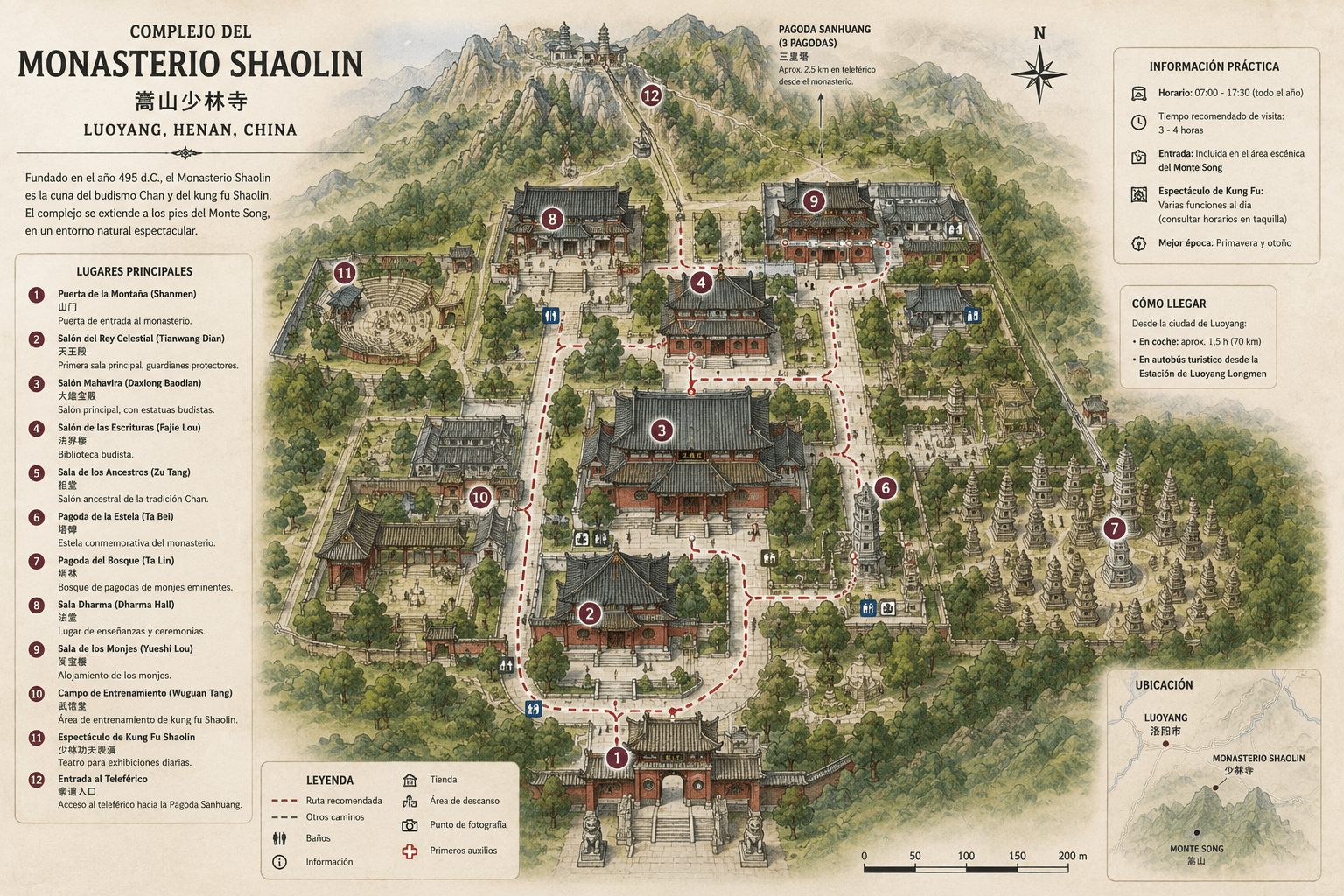
The first thing you’ll come across (and the best part, in my opinion) is a huge training ground where the kids practice all kinds of moves: somersaults, attacks with various types of weapons, general physical training… it’s amazing. It’s not something they do just for the tourists; it’s part of these kids’ regular routine, and it’s great to see the dedication and effort they put into it.

Past the training arena, there’s a pavilion where the monks do put on a show for tourists—which the blog author chose to skip because he suspected it was a “tourist trap.” I got the impression it took place every hour, though I didn’t note the schedule.
A little further on is the temple itself, which is quite lively for what these places are usually like

It's true that there are almost no signs in English, but I don't think it's worth paying a fortune for a Chinese guide who you can tell is just going through the motions, as if he were a tape recorder….
Driven by my curiosity and encouraged by a sign in English, I first wandered into the “Daily Affairs Office” and then the “International Relations” office at the temple to see if I could find a friendly monk to serve as my (free) guide.

After turning on the charm (and relying on Google Translate), I only got a mild scolding for sneaking into his office. You can't always win...
This monastery offers many more activities, but remember that the last bus to Luoyang leaves at 6:30 p.m. You can follow my example and climb a mountain up endless steps to the cave where Monk Bodhidharma meditated for those nine long years.

…or take the funicular that takes you to another mountain and walk back down (since I wasted my time climbing that little hill, I ended up missing out on the funicular)
My advice is to try to get there as early as possible. It was pretty nice until around 12:00–13:00, but then hordes of tour groups arrived (I suspect it coincided with the start of the kung fu performance I mentioned earlier), and the place lost some of its charm….
The complex has many more rooms, yes… but they’re either living quarters for the monks and students or strictly dedicated places of worship. It’s up to each person to take or post photos of these; I personally don’t usually do that, and anyway, it’s more fun to see them for the first time when you’re actually there rather than on a blog 😉
Well, more information is available on their official website: http://www.shaolin.org.cn/en/
BONUS: TALKING ABOUT FOOD
I don't know anything about food. Nothing. That said, in some non-touristy places, we might have a really hard time ordering food at local restaurants because either there's no menu or it's written in Chinese.
If you just want to get by and eat something simple, the dish in the photo is a staple for everyday people: a kind of vegetarian noodle dish.

No matter which restaurant you're at in China: if you show them this photo, they'll always have this go-to dish on hand 🙂
At a local restaurant, they'll charge you 10 RMB, and at a more touristy one, about 20–28 RMB; if there’s one thing that surprised me about China, it’s the “standardization” of food prices at non-touristy restaurants: they all have a sort of huge, long red sign with a bunch of “10”s written next to Chinese characters, and this is one of their typical dishes. I’ll write more about Chinese food in future posts 🙂
Well, there you go—no more wondering what to do in Luoyang… As always, if you have more information or want to leave a comment, feel free to do so!!!
If you want to read more about China: https://999millas.net/category/paises/china/
Texto y fotos: Mike !
 EN
EN  ES
ES