Pingyao
Surprisingly, no one talks about what to do in Pingyao, even though it’s set to become one of China’s most popular tourist destinations in just a few years…
If I had to draw a parallel between Pingyao and another city in the world, I would choose Santiago de Compostela: a medieval city whose old town has been preserved almost in its entirety

For one of China's most popular tourist destinations, there's actually very little reliable information: the Chinese government's official website isn't working, and the UNESCO site doesn't really say much, to be honest…. : https://whc.unesco.org/en/list/812/
As always, the best information comes from being out in the field, so let's see what I was able to discover during my three days here….
QUE HACER EN PINGYAO: LLEGANDO, SALIENDO Y MOVIENDOTE POR LA CIUDAD
The bus station is located north of the old town, about a 10- to 15-minute walk away, so it's not even worth taking a taxi.
There are two train stations:
1. The old one, where the “regular” trains depart (also about 1.5–2 km from the North Gate) and
2. The new one, where the bullet trains depart from. This station is quite far from downtown, about 7 km southwest of the city. Bus 108 can take you there, although the ride is “long,” and a taxi for about 20 RMB will get you there faster.
Where to stay?
Well, obviously, the Old Town seems like the best option.
I personally stayed somewhere else, haha…outside Old Town but close by
Advantages?: cheaper, more authentic, and more “local” restaurants (where the Chinese eat, not the tourists); we’ll come back to the topic of food at the end of the post, so don’t worry

Downsides? It's a little dull; once the sun goes down, everything closes and it gets kind of dead…
Within the old town, there’s one thing I noticed while exploring the city walls that’s worth mentioning: in the areas closest to the walls, new hotels were constantly opening, but the neighborhoods themselves weren’t developed enough, so you could end up staying at a really cool hotel on a block where… there’s nothing but ruins and empty buildings.
Getting around
In addition to the ever-present motorcycles and bicycles, the city government has introduced some hideous electric carts that you’ll have to dodge as you walk through Pingyao; if you don’t want to (or can’t) explore the city on foot, there are plenty of these carts available at the North Gate.
WHAT TO SEE IN PINGYAO THE VISIT
Let's get down to business: what to do in Pingyao?
To return to what I was saying earlier, Pingyao is a city undergoing constant restoration: if you venture a little off the main streets (the two main avenues that run perpendicular to each other), you’ll come face to face with reality.
Indeed, there are plenty of empty houses that are gradually being turned into shops, restaurants, hotels, and so on, so you can split your visit here between the overwhelmingly touristy spots and getting lost in its abandoned alleys to see what surprises you might stumble upon.
Let's get right to the sightseeing

The Pingyao City Government has introduced a single ticket, valid for 3 days, that grants access to all attractions (130 RMB); it can be purchased at any of the numerous ticket booths throughout the city (the most convenient ones are located at the north and south gates and at the intersection of the two main avenues in the old city).
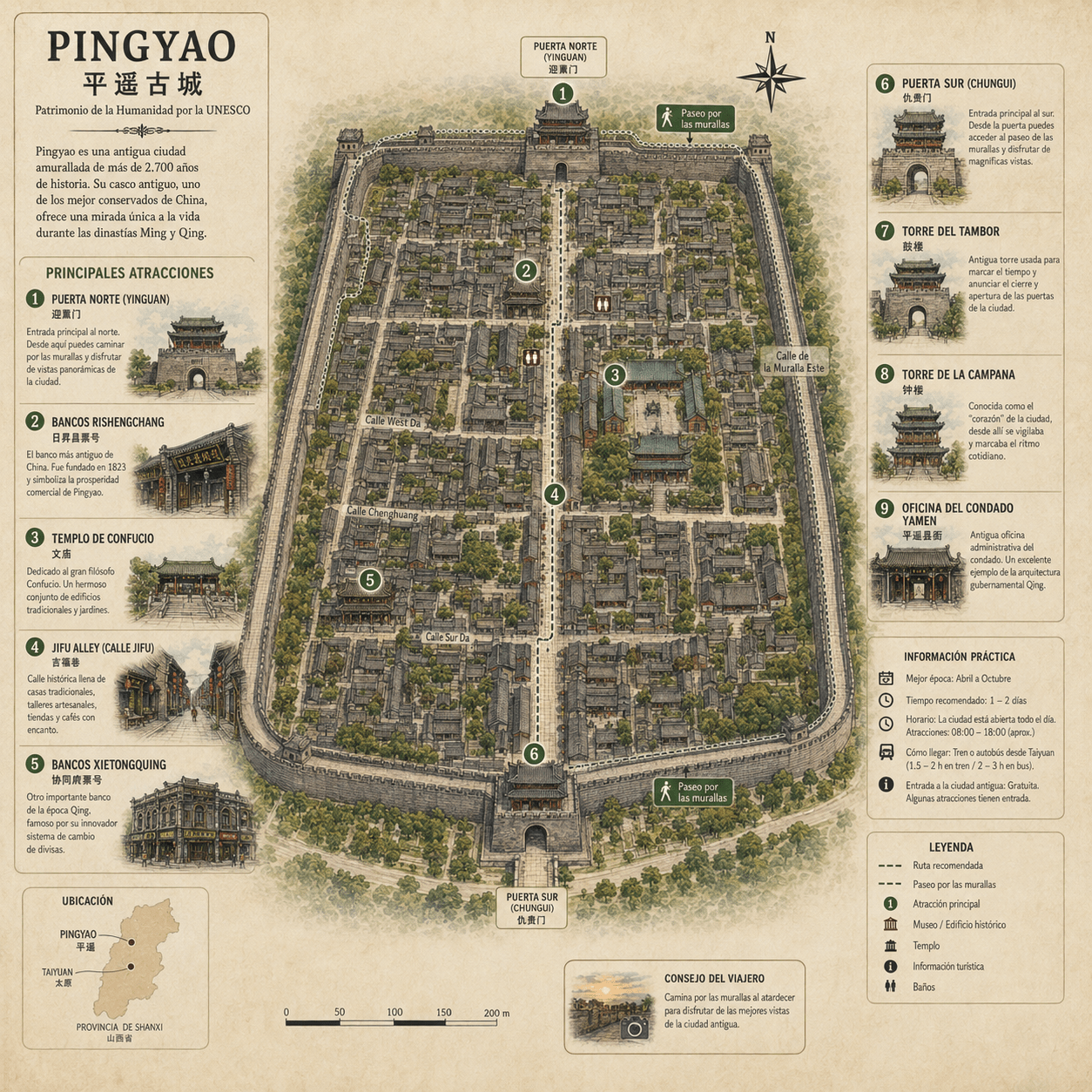
There are so many buildings you can visit with this ticket, and, to be honest, they do get a little repetitive after a while; here are some of the most representative ones:
1.- Old Banks

I mean, the old banks, not the new ones.
Pingyao is the birthplace of modern banking in China and revolutionized global trade by creating the Piaohao (票号) or “bill of exchange banks.” Before their emergence in 1823, merchants had to transport tons of silver ingots in wagons, protected from bandits by armed escorts—a slow, costly, and dangerous process.
China's first bank (Rishengchang) was a game-changer: you deposited money at a branch, received a paper document, and could safely cash it in on the other side of the empire. The system was so advanced that it managed more than half of the Qing dynasty's economy.
There are two different museums you can visit: the aforementioned Rishengchang Museum and the more modest (and less crowded) Xietongquing Museum. While you can explore on your own (there are explanatory panels in English), the best option might be to take a guided tour; in fact, I was one of the few crazy people who did it on my own….
Interestingly, I got the impression that the bank (the photos are from the Xietongquing Museum) was still in operation: they had a currency exchange counter and several offices with tellers working at the counters.
He was standing there guarding the entrance to the basement, where the ingots in the photo above are kept, and he wasn't very friendly, haha (I had to take the photo of him on the sly).
2.- Confucius Temple
The Chinese were the first to devise the open competitive examination system for entry into the civil service, and this is where candidates have traditionally taken the exams (in fact, the desks where the exams were held are still preserved).
If you've already seen a temple in China, this one won't impress you all that much, but I'm including it here because of the great views of the city you can enjoy from there
3.- 3.- A Walk Along the City Walls
What seemed to be undoubtedly one of Pingyao's highlights turned out to be quite disappointing. You can access the city wall through the north or south gate, and, yes, the first impression is fantastic….
…but then, as you walk along it, you don’t really see anything all that spectacular, since the parts of the city closest to the wall are precisely the ones that haven’t been renovated and are somewhat dilapidated. Also, unlike other walled cities (such as Xi’an), I don’t recall there being any bicycles available to ride along the wall, so the walk can be a bit less lively.
As a first introduction to Pingyao, I think the best thing to do is to take a stroll with no particular destination in mind and let the city surprise you with scenes like this:
This “parade” was held to mark the 70th anniversary of the Communist Party. Similar events were held throughout the country. It was truly impressive to see how the authorities mobilized the population for this event: flags (thousands of them), parades, etc.
4.-Pingyao...by night
It's much better to visit Pingyao at night than during the day, although unless you wait until the early hours of the morning, it's still crowded.
A good excuse to do that is to go out for tapas.
The city had the great idea of creating a sort of food court—in this case, a long street running north to south called Jifu Alley. You'll find it just a few meters from the West Gate—a long street running north to south with eye-catching lights lining it.
So, tapas and “designer” food made by and for tourists in a very pleasant atmosphere… although at prices premium, of course (you might pay as much as 10 RMB for a tapa, which is the price of a dish at a non-tourist restaurant).
Let's now explore the more authentic, traditional side of Pingyao—the one you don't see in travel agency photos
The hidden Pingyao
I'm trying to figure out how the Chinese live in the historic district, since there don't seem to be any supermarkets, pharmacies, etc., there.
Most of them don't walk: they ride very, very small electric motorcycles (they look like bikes with a battery tacked on in a slapdash way), and among the younger crowd, scooters are becoming increasingly popular.
On Pingyao’s main avenues, the authorities have set up a kind of barrier to prevent these vehicles from passing through. I suppose their intention is to have people walk along these streets, but that plan has been thwarted by the stubborn resistance of the residents, who simply stop at the barrier, go around it, and keep driving….
As you walk through the non-touristy side streets, you come across the homes of ordinary people… What are they like?
It’s interesting to observe the layout of the buildings here: they feature a very narrow, open doorway that faces the street, which then makes a 90-degree turn leading into the house itself (which is hidden from the view of passersby). These entrances feature all kinds of decorations—some with classical medallions, most with altars dedicated (I presume) to their household gods or ancestors, and others with a more… political slant.
Although it's tempting to sneak a peek at these porches, remember that they're the neighbors' homes, and they don't really appreciate you barging in, camera in hand, to spy on their homes….
If you keep looking around, you might come across a scene like this—pure traditional commerce, I suppose…

Things to Do in Pingyao: A Few Random Thoughts on Food
On my first day in Pingyao, I went to a local restaurant.
After ordering some food “on a whim,” the awkward moment of the day arrived: they served me a tea set, perfectly wrapped in plastic.
As I removed the plastic, I glanced discreetly from side to side to figure out what to do, since there was no tea—neither in the “pack” nor on the table.
I got up, pretending I was going to the bathroom, so I could walk past the restaurant counter and see if that was where you were supposed to return the tea bags……? Well, no.
Apparently, they just serve you boiling water in a clean, sterile “pack”; if you want to add anything to it, you have to bring it from home…
If I had to pick a local specialty, it would be these rolls: practically every restaurant had a multi-tiered brass-like stove set up outside where they cooked them. I tried a couple of them at different places—one with meat, the other with vegetables… both were delicious and very filling.
The prices are the ones they charge tourists and are a bit arbitrary: one day it's 10 RMB, another day 7… depending on the day and whether you want to be a pain and haggle
A DAY TRIP: WANG FAMILY COURTYARD
Not only are there things to do in Pingyao itself, but there are also several day trips
Of the many tours available in Pingyao, I chose this one because it seemed like the most reasonable option.
The Wang family made their fortune through trade, and there was no way the neighbors wouldn't notice how well they were doing.
It’s a huge mansion/castle located about an hour (by taxi) from Pingyao. The name “Courtyard” comes from the countless courtyards that connect its various rooms, and it seems to be immensely popular among Chinese tourists, judging by the hordes of tour groups I encountered there.
Although at first, in the initial courtyards, the experience can be disappointing (there are so many people that you can't even move forward), the mansion is so huge that you can find spots of (relative) solitude and enjoy the visit.
Hotels can arrange a shared taxi for you with guests from other hotels, and for 50 RMB you’ll be there (incredibly cheap compared to the exorbitant prices of tours in China), and admission costs 55 RMB for a visit lasting about two hours.
Be sure to try the local culinary specialty in this part of Pingyao: roasted apples!
In these quirky ovens, the vendors would arrange their apples in rows and then hand them to you, just like roasted chestnuts here in Spain; be sure to grab a napkin because no matter how hard you try, you’re still going to get messy when you eat them….
To sum up, Pingyao is a beautiful place that’s well-suited for tourism and growing day by day. It’s easy to visit since everything is concentrated within the walled city, which—for China—is quite small.
If you're in Beijing, it's a relatively easy and short trip (about 5 hours by train), so be sure to stop by here

Well, I hope I've helped you figure out what to do in Pingyao; personally, it's one of my favorite places in China.
Whether you liked this post (or not) and/or have any additional input, please let me know!!!!
...and to learn more about China: https://999millas.net/category/paises/china/
Texto y fotos: Mike !
 EN
EN  ES
ES