
Datong
It doesn't seem like anything special, does it? But there are things to do in Datong.
For starters, you're not going to Datong, but to “Tatong” (with a very tight “o”).
Arriving and departing
To get from Beijing to Datong, you have to go to Liuliqiao bus station (metro station of the same name, lines 9 and 10); avoid being as stupid as the author of this blog, who got the name wrong and ended up at Lishuiqiao metro station (on the other side of the city, of course...), frantically searching for a bus station that didn't exist...
The bus costs 163 RMB and takes between 4-5 hours. While I was researching the frequency of this bus, everywhere I looked said that one left every 30-50 minutes. That sounded good. Well, I arrived at the station at 10:30 a.m. and there was only one at 12:40 p.m. (full) and the next one at 2:40 p.m....maybe it was because it was Sunday, who knows...
Theoretically, the bus should have dropped me off at the station near the north gate of Datong, but that would have been too easy, right? So it dropped me off at a stop far away from the highway, with all the taxi drivers drooling with delight, sensing that they were going to rip me off.
I get off the bus. The first one approaches. We go to the car and I show him the address. Everything is fine so far. He takes the usual photos of the cool places in Datong so that I will hire him tomorrow... and I say no, while pointing to the address of the hostel and the taxi meter.
He didn't like that last comment. He shows me a 50 RMB note, indicating that this is the price, and I laugh in his face (it's like being charged 150 euros to go from Madrid or Barcelona airport to the city center). Here, the initial charge is 7 RMB and 1.6 RMB/km, so do the math on this attempted scam.
But I have to say that this was the only jerk I encountered in Datong because everyone here is extremely friendly. At the bus station itself, a Chinese family “adopted” me and offered to take me with them in the transport they had hired from their hotel. As it didn't arrive and it was getting dark, they convinced a guy who was there to take me to the city for free—about a 7 km walk—and once there, another family, seeing me lost, literally guided me to the door of the hostel. Wow.
Visiting Datong: what can we see?
Let's get down to business: what to do in Datong?
Surprisingly, when we arrived in Datong during the off-season, some attractions were free. This was funny: you would find a ticket office, but:
Esto era gracioso: te encontrabas una taquilla pero:
- With the cashier inside taking a nap or playing with her cell phone
- The dismantled lathes and
- In general, people coming and going as if nothing had happened... Great!
1.- Yungang Grottoes

An entire mountain carved out and filled with giant sculptures is well worth a visit.
How did it all begin?
Between 446 and 452 AD, a Chinese emperor named Taiwu, influenced by Taoism and his court advisors, unleashed the first major persecution of Buddhism in China. Temples were destroyed, sacred texts were burned, and numerous monks were executed. After Taiwu’s death, the new emperor, Wencheng, ascended the throne with the firm intention of restoring Buddhism. The excavation of the grottoes served as a massive act of atonement and reparation for the damage caused to the faith. Translated with DeepL.com (free version)
In the year 460 A.D., the next emperor approved the project proposed by the eminent monk-teacher Tan Yao. Tan Yao led thousands of artisans to begin quarrying sandstone from the Wuzhou Mountains, about 16 kilometers west of the capital. The first five carved structures (now known as Caves 16 through 20 or “The Five Caves of Tan Yao”) were designed with a radical political intent: to merge the figure of the Emperor with that of the Buddha. Each of the main colossal statues in these caves depicted the features of the first five emperors of the Northern Wei Dynasty
This is directly connected to the so-called Colossal Buddha shown in the photo above—13.7 meters of political propaganda in the service of the emperor who commissioned its construction. By endowing the statue with colossal proportions and placing it on the same level as the deities, the Northern Wei dynasty proclaimed the concept that the ruling emperor was the living Buddha on Earth, inextricably linking political power with sacred authority.
But there are many, many more statues…

Unfortunately, photography is prohibited for the most impressive sculptures (which everyone except me ignored), so you'll have to go and see them for yourself to appreciate how impressive they are.
The 120 RMB entrance fee to the complex (expensive for China) is more than worth it in this case. The complex is quite large, so set aside at least 2 hours to explore it at a leisurely pace amid the crowds… Here’s a map of the complex.

How do we get there? I’m posting this informational brochure, courtesy of my hostel. First, head to the South Gate of the Old City (called Ying Bin Jie). There, you’ll see a huge street running from east to west. Once on that street, look for the bus stop for bus No. 17 (the bus stops are clearly and simply marked) and take it heading west. Once on the bus, ask the driver to let you off at bus stop number 3, which is the one that leaves the city and takes you to the caves (or just tell him you’re going to the caves and ask him to let you know where to get off).

2.- The ancient city
Apart from the wall (explanation below), the interior is being rebuilt with buildings as they were originally; curiously, they are not homes but are all intended to be shops, restaurants, etc. This means that it is still “uninhabited,” which creates an unsettling feeling of a movie set: the whole neighborhood is very beautiful, but... no one lives there!
I got the impression that this is how everything is done in China now: the government (whether regional, local, or whatever) comes up with good ideas, puts up the money to implement them, but in the end, a certain lack of foresight + a certain lack of interest on the part of the local population + rushing things means that the projects end up somewhat soulless, as if you were to build a huge cathedral and in the end no one used it to pray....

Well, once you reach the center of the square that is the old town coming from the south, on the right-hand side of the small castle at the roundabout, you will find a street full of cafes and lots of streets to explore.

But the best thing about the old city is the enormous wall that surrounds it. You can climb up and walk along it, and it's so huge and long that they rent bikes because otherwise you'd have to walk 5-6 km... (what you see in the photo below is a small section that can be accessed from the south gate).

They are open until 10:00 p.m., so you can come here at dusk to watch the sunset or see the wall lit up at night. In summer, admission costs 30 RMB.
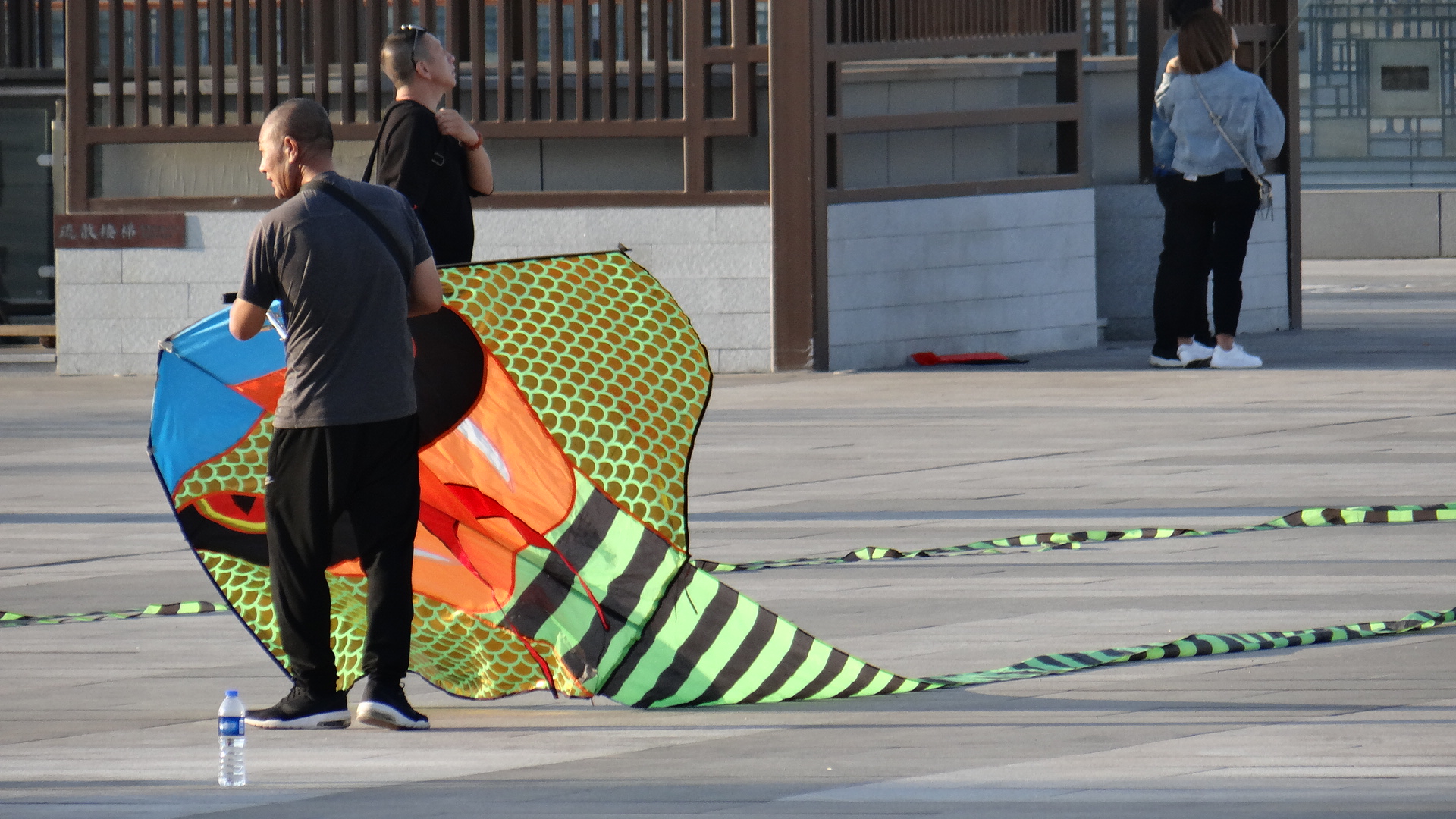
Speaking of the south gate, if you leave through it in the afternoon, you will enjoy the spectacle of the kites flown by these neighbors to the delight of the children (and me).
So, this is what to do in Datong... I don't recommend spending more than a day and a half here, to be honest, although if you want to get to know a “normal” Chinese city (not touristy or Westernized), it's a good place to visit.
If you want to know more about China: https://999millas.net/category/paises/china/
Or here, on UNESCO's official website: https://whc.unesco.org/en/list/1039/
And finally, if you found this post useful or think it's rubbish, let me know in the comments!
Texto y fotos : Mike !
 EN
EN  ES
ES