
Jakarta: Not Just a Stopover
Okay, so you land in Indonesia and have a couple of days to spare before catching your next flight… What can you do in Jakarta during those days? Let's get right to it….
“Welcome to Jakarta” reads one of the signs you see when you leave the airport… thank goodness the people of Jakarta are so charming, because the city is one of the most hostile to pedestrians and one of the hardest places I can remember to walk around at a leisurely pace.

Traffic lights are about as useful as a Christmas tree, and crosswalks are just white marks on the road… Some might think Hanoi or Palermo are the same, but Jakarta goes beyond anything you’ve ever seen: the tourist spots in the city center are “surrounded” by extremely wide roads (three or four lanes), and crossing them is quite an adventure 😅
WHAT TO SEE IN JAKARTA
In a couple of days at most, you can cover the most important points
Monas Park

This strange tower stands in a huge park in downtown Jakarta; it was one of Sukarno's last acts while in power.
The park is huge, but strangely enough, its entrances are extremely hidden and narrow. Supposedly, after paying at the ticket booth, you can go all the way to the top to “enjoy” the views of Jakarta, but the truth is that the city doesn’t have a skyline impressive enough—in my opinion—to make the climb worthwhile.
Istiqlal Mosque

Ramadan: Dozens of people lie on the floor or lean against the metal columns of this mosque. Next to them, a bottle of water. Exhausted, they lift their heads with effort to cast an indifferent glance at the tourists….
For me, this is a must-see on your list of things to do in Jakarta

The mosque is the largest Islamic monument in Southeast Asia: it is a 5-story metal colossus (representing the five pillars of Islam) with a dome 45 meters in diameter. The word «Istiqlal» The name comes from Arabic and means “Independence.” Plans for its construction were conceived after Indonesia’s liberation from Dutch colonial rule as a way to commemorate the country’s independence.
It's open every day from sunrise, and admission is free, but you can't visit on your own—you must always be accompanied by one of their guides. Unfortunately, they don't let you see the whole place either; they only let you go up to the upper balconies so you can take a few photos, and that's it.

To top it all off, you’re going to have to put on this tacky robe and practically drag the words out of the guide—they aren’t very talkative… except when it comes to asking for the customary tip at the end of the tour 😓 I left him 10,000 Rp and he made a face like he was disgusted—that’s when the guy really showed his true colors…
Next to the mosque there's a madrasa, but they won't let you in—not even if you offer the guard a tip. I was more generous this time, but it didn't work…
The Cathedral

Right across from the mosque is the Jakarta Cathedral. It was built before the mosque, and the idea behind building them across from each other was to highlight religious coexistence in Indonesia.
As you can see, the three spires are…strange. They’re made of wrought iron and were constructed from metal instead of stone to make the building lighter and more earthquake-resistant.
Stepping inside is a delight, as birds fly in through the windows and you can enjoy a true concert of nature, amplified by the Gothic arches of the central nave.
Museum Nasional
Yes, that's spelled correctly—it's “Nasional” 😎

For just 10,000 Rp, you can visit the best museum in Jakarta—and probably in all of Indonesia. It’s organized by region—by island—and is well worth a visit, with some truly amazing exhibits.
For more information: http://www.museumnasional.or.id
Kota

No, it's not Havana. Nor is it Cartagena de Indias. Nor is it Spain. It's the maritime museum in Jakarta, in the Kota neighborhood, which was founded by the Dutch when they arrived in Java.
To take a stroll through this square, we need to know a little about the history of the Dutch East India Company. This forerunner of modern multinational corporations sought to gain a monopoly on spices (nutmeg, cloves, etc.) in this region and subjugated the local population to achieve this goal.
Before the arrival of the Dutch, the place was a thriving commercial port of the Sultanate of Banten called Jayakarta. In 1619, seeking a central, fortified, and strategic port for his ships, Governor Jan Pieterszoon Coen laid siege to the city and razed it to the ground, expelling its inhabitants; on the ashes of Jayakarta, he built a new walled city, which they named Batavia (the historical name of the region in the Netherlands).

The Dutch East India Company built this and other similar warehouses to store the spices it regularly shipped to Europe: enormous buildings with red-tiled roofs and pointed gables that surround both the harbor itself and a small canal that leads into the city.
These particular buildings are located on the Taman Fatahillah, something like the city's main square, which served as the seat of the Dutch governing bodies for this territory.
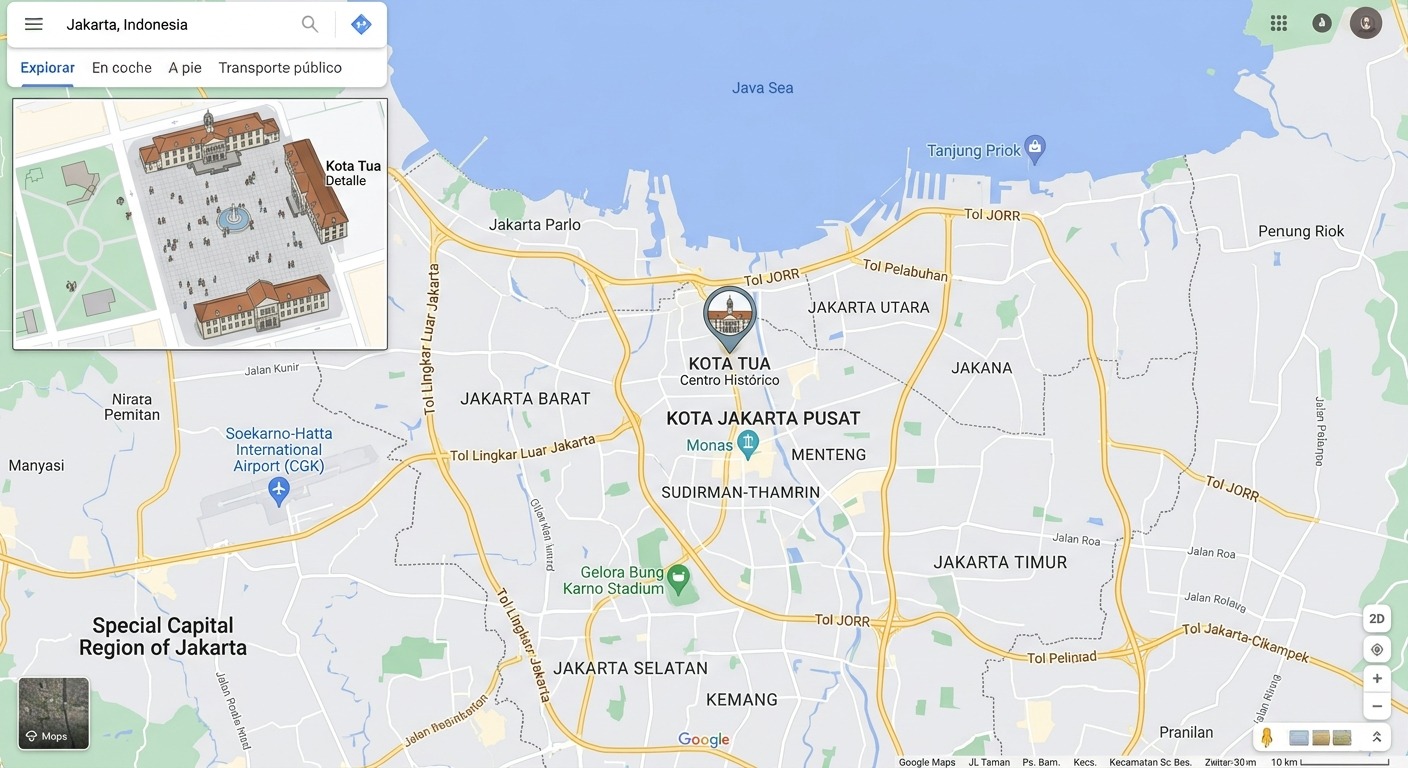
The square is wonderful at sunset when they set up a big flea market and musicians and puppeteers show up with all their gear. There aren't any annoying people here bothering you with their taxis and their stories—just the locals enjoying life.

And this, to me, is the true image of Indonesians: not the four idiots who try to rip you off in taxis, at bus stations, and so on, but these simple, cheerful people, always ready to laugh—they’re laughing all day long—and to give you a helping hand without expecting anything in return.
If you liked this post or have more information to add, let me know in the comments!
And if you want to know more about Indonesia: https://999millas.net/category/paises/indonesia/
Texto y fotos : Mike !
 EN
 ES