Benares
What to see in Benares? “Older than history and even older than legends”—that’s how Mark Twain described Benares, so you can imagine there’s a lot to see, and it’s very diverse.
Varanasi (Benares in Spanish) derives from Kashi which means “City of Light.” For Hindus, Benares is the holiest place on Earth. It is believed that anyone who dies here, or whose ashes are scattered into the Ganges, breaks the eternal cycle of reincarnation (samsara) and attains immediate spiritual liberation (moksha).
Keep all of this in mind as you explore the city and its most important religious sites; even if what you see surprises you or you like (or dislike) it, you must always show respect.
WHAT TO SEE IN VARANASI: THE GHAT
The first things to see in Varanasi are its gaht, Without a doubt, the most photographed spot in this city.

What are the ghat? In Sanskrit, the word “ghat” literally means a series of stone steps or a set of terraces leading down to a body of water—in this case, the Ganges. As you can see in the photo above, nearly 88 ghats stretch along the western bank of the Ganges in an arc spanning about 7 kilometers, and each one has its own name, guardian deity, and specific purpose.

To visit Varanasi, you have to understand that everything revolves around the Ganges River. According to Hindu mythology, the Ganges fell from the sky to Earth and was cushioned by the hair of the god Shiva so that its impact would not destroy the planet. For this reason, it is believed that its waters possess a heavenly purity capable of cleansing negative karma and absolving any sin.
The ghats throughout the day
Every hour of the day has its own ritual at these ghats and on the Ganges; let's take a look at what you can do here at different times of the day.
The Snan: the morning swim and the sunrise tour
Even before dawn, there is already activity on the river: it is the Snan, the morning bath. Dozens of pilgrims make their way down the ghats to immerse oneself completely in the river three times and purify oneself.
There are many hotels that offer a sunrise boat tour, since the sun rises right over the Ganges. It shouldn't cost you more than 300 Rps per person. There's also the option of going all the way to the ghat If you'd like, just before sunrise, talk to any of the fishermen over there and see if you can get a slightly better price, although the difference isn't really that big.
Personally, I found it more interesting to watch the sunrise from the ghats; you can see people arriving from the surrounding neighborhoods with their towels, mats, and other gear, ready for a swim.
2. Doing the laundry
After having breakfast out and about, I stopped by the river again to try to take some good photos. To my surprise (and delight), I saw that, for the indigenous people, a river is still just a river, and they were calmly doing their laundry there…

…and that people would hang their clothes out to dry on the steps of the ghats as if it were no big deal

3.- The shadus: the devotees of renunciation
As you stroll along the ghats, you'll come across lots of men like the one in the photo below.
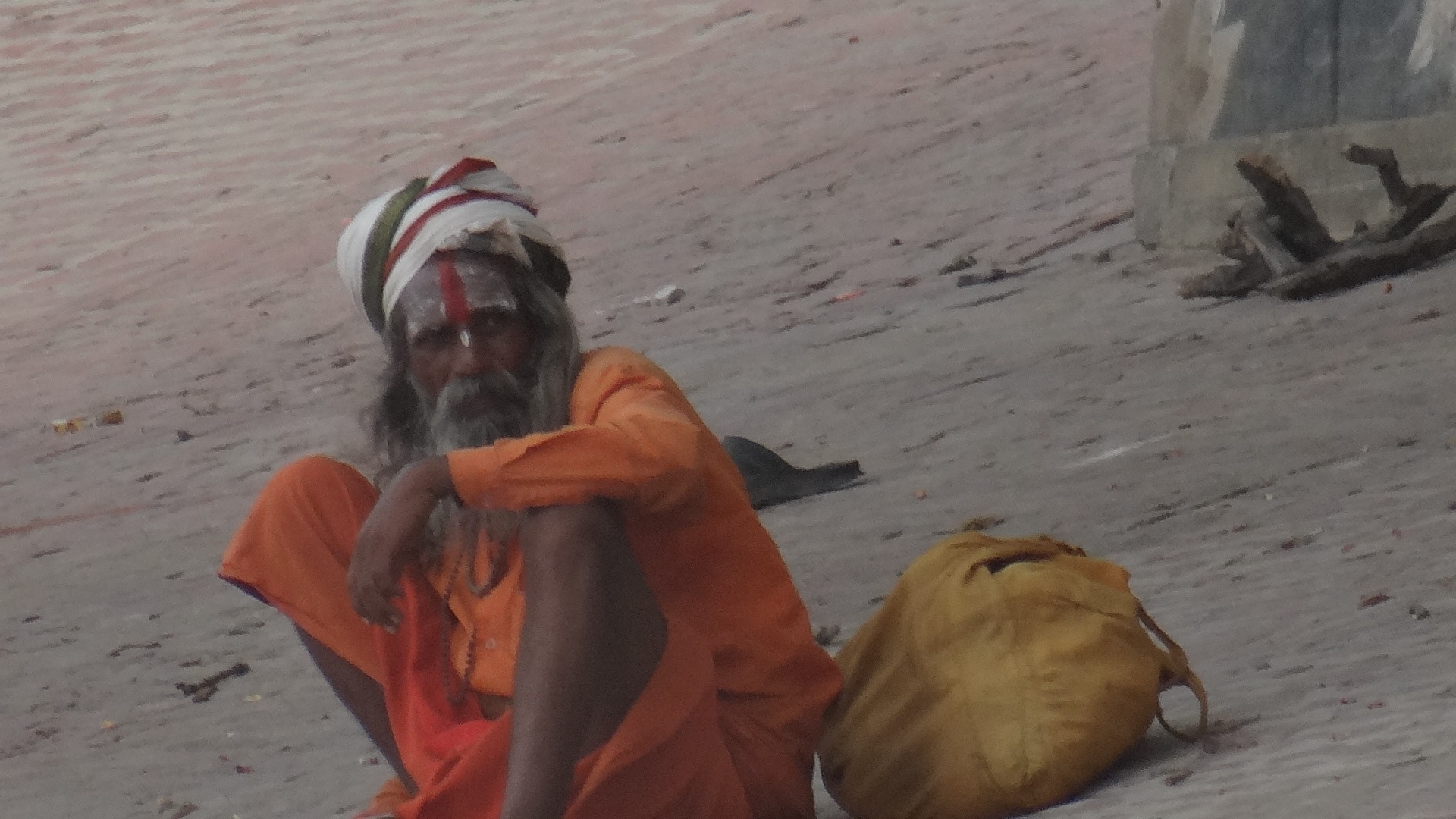
This gentleman is a shadu, a man who has renounced everything (money, prestige, sex, etc.) to achieve spiritual enlightenment. The orange robe obviously does not mean that he is a Buddhist, but rather symbolizes his renunciation of worldly desires, and the markings on his face (called tilak) They identify which deity they worship (usually Shiva or Vishnu). They are believed to live on the streets or directly on the ghats and survive on alms from the public.
4. Cremations
A pile of wood crammed together and a goat or two trotting around. It's not something that has any special meaning in India…unless you're in Varanasi.

At any time of day, you’ll come across people carrying a mat with a body wrapped in fabrics of varying degrees of colorfulness. With the logs you see above, the raft is already set up—they’ll place the body on it, then set it adrift on the Ganges to be cremated.
As I mentioned above, being born in the Ganges represents, for Indians, Moksha—the ultimate liberation of the soul—breaking the painful cycle of reincarnation (samsara) to merge with the divine.
I saw it up close once by chance, and I think it was one of the few times I’ve “heard” silence in India; as they placed the deceased in the boat, the silence and respect were absolute: no shouting, no cell phone selfies, nothing…
5.- The sunset: the Ganga Aartri
Every evening, you’ll witness this ceremony, which is observed en masse by Indians day after day: the Ganga Aarti. It is an offering of light and devotion dedicated to the goddess Ganga—the personification of the sacred Ganges River—and to the god Shiva. At the start of the ceremony, Hindu priests (Brahmins) dressed in traditional saffron-colored silk robes take their places on individual raised altars facing the river..

The ceremony involves lighting a kind of brass lamp and passing it around at high speed to the beat of drums, tambourines, and whatever else is available. The light from the lamps is supposed to dispel darkness and ignorance.
It's impossible to take a good photo right now. There are so many Indians standing, sitting, lying on the ground, or walking around with their cell phones in hand that you simply don't have any physical space to squeeze into. The truth is that the devotion is overwhelming, and beyond watching the ceremony itself—which is truly spectacular thanks to the choreography performed by the priests—seeing the faithful is a spectacle in and of itself.
Here are some practical tips for visiting the gahts:
1. Walk along it from south to north—that is, from Assi Ghat to the famous Dasaswamedh Ghat. The ghat The ones in the north are much more spectacular than those in the south, so I think it's best to start small and work your way up.

2. DO NOT take photos of the cremation ceremony. It is strictly forbidden, and if you get caught, you could get into a bit of trouble. You can quietly admire it from anywhere, although the family of the deceased usually reserves a spot on the “spurs” that jut out over the river.
3. A Few Words About Safety
I didn't think it was an unsafe area at all. I was there at all hours of the day (including 4:30 a.m., and on my own) and never had a bad feeling. Some idiot is going to offer you drugs. You know what to say. Others offer free tours. In India, nothing is free. You've been warned…
WHAT TO SEE IN VARANASI: THE OLD TOWN
Another must-see in Varanasi: the Old Quarter.
The area immediately adjacent to the ghat It’s the old neighborhood, a labyrinth of dirty alleys teeming with cows and flies….Getting lost here is easy, and it’s a real eye-opener for anyone unfamiliar with the true poverty in which a large part of India’s population lives.
In theory, motor vehicles aren't allowed—only electric or pedal-powered tuk-tuks—so don't be surprised if you ask a driver to take you there and he refuses or doesn't park exactly where you ask.
One more thing: I've never been overly cautious when it comes to safety, but I don't recommend that a woman go alone down these streets—there are too many alleys and half-empty or dilapidated houses where you could run into trouble if you let your guard down.
The temples
A different way to explore Varanasi is through its temples, starting with the most humble ones in the ghats even the most majestic ones; here are a few to help you plan a route through the Barrio Viejos neighborhood

If I had to recommend one, I'd say the Monkey Temple (highly recommended—unless you hate monkeys, of course).

This enormous red sandstone structure is, in fact, full of monkeys inside. Be careful with your belongings—especially if you have food in your backpack or something like that—because it’s very easy to end up without lunch. Photography isn’t allowed inside, and you have to leave your camera and cell phone at the entrance.
A relaxing stop
On our tour of Varanasi, we'll have to grab a bite to eat, right?
I'm not really one to recommend restaurants or places, but if you like or want to try a lassi Be sure to stop by the Blue Lassi Shop in the old part of town, very close to Manikarnika Ghat or the Kashi Vishwanath Temple.
I haven't found an official website for it, so here's what the all-knowing TripAdvisor has to say: https://www.tripadvisor.es/Restaurant_Review-g297685-d3625222-Reviews-Blue_Lassi-Varanasi_Varanasi_District_Uttar_Pradesh.html

The lassi It's a kind of yogurt that's eaten cold with fruit added. At this place, which is super touristy, they charged about 60 Rps, while at regular spots it was around 40-45…!! But it was really delicious!!
They also have a habit of taking photos of customers and putting them on the wall, so I've already become part of this place's little history 🙂

As you walk down the main street in this part of town, which runs north to south, keep an eye out for a narrow entrance on the right-hand side of the sidewalk where there’s a small, weathered sign stuck to the wall telling you it’s 25 meters away (I mention this because Google Maps and Maps.me aren’t very reliable in these narrow streets…).
GETTING AROUND THE CITY
A standard tuk-tuk ride (3–5 km) shouldn't cost more than 70 Rps if you're riding alone; if you're sharing a ride with others, make sure they don't charge you more than 15.
From the Varanasi Junction train station to the old part of the city, the official fare—posted on the cab of the prepaid taxi outside—is 70 rupees. Drivers insist that this fare is outdated and will charge you between 100 and 150 rupees, depending on your patience and bargaining skills.
For those looking for train tickets to or from Varanasi, keep in mind that Varanasi Junction isn't the only nearby train station: About 20 km away is the massive Mughal Sarai Station, a major transportation hub in this part of India. It costs about 400 rupees to get to the station by tuk-tuk, and the trip takes about an hour.
SOME SCAMS...
How many times have I seen this scam? And why do people keep falling for it?
A guy comes up to you—the younger, the better—and chats with you friendly for a few minutes. It seems like you two hit it off. He’s really nice. Then he tells you about his parents. They have:
* A school
* A shop
* A workshop
And he invites you to visit him. Be careful, be careful… you might end up in a store on the outskirts, all by yourself, surrounded by people pressuring you to make a “donation” or buy something from them. Years ago in Morocco, someone pulled this stunt on me, and I ended up in an underground warehouse with two huge Moroccans who wouldn't let me leave unless I bought something from them… Fortunately, I held out against the siege and managed to escape alive with my wallet intact ☺️
Here's another scam: “VIP box to watch a cremation”:
Since we were talking about cremations, I’m sure that while you’re calmly watching the preparations, a very friendly man will approach you and offer you a good spot to watch. A classic Varanasi scam in the making. Chances are, you’ll end up having to pay him a commission for the “favor.”
Come on, here's another one: the pashminas and the silk.
The heat is brutal in Varanasi, and both men and women protect themselves from the relentless sun with pashminas, shirts tied around the head, or whatever you happen to have on hand at the time

Following on from this, some smart aleck is going to tell you about the exceptional quality of the silk produced in Varanasi. This guy also has a contact at one of the factories that supply small businesses, so if you're interested in buying something, he'll generously and selflessly help you… as soon as you say yes, he'll take you around to all his friends' stores, ready to give you a “special price” for being such a savvy tourist.
My conclusion: 99% of Indians who approach you to talk are after money or, if you’re a woman, something else…. Don’t get me wrong. In India, “ordinary people” (for example, a man who owns a bakery or an office worker) will help you—for free and selflessly—but they don’t spontaneously approach you on the street; instead, they go about their business minding their own affairs. The dangerous ones are precisely those who, using any excuse, stop you on the street to:
* practice Spanish or English
* Ask yourself if you're lost or where you're going
* Tell you about an NGO, school, or other charitable activity or something similar
WHAT TO SEE IN VARANASI: ONE DAY TRIP TO RAMNAGAR FORT
What’s there to see in Benares that’s a little different? Far to the south of Varanasi, across the river, you’ll find this small fortress, Ramnagar Fort.

It's supposed to be the current residence of the Maharaja of Benares, so the visit looked promising, but when it came down to it, it's in pretty poor condition and the visit turned out to be a bit of a letdown. It houses a small, dirty, and run-down museum with a whole array of artifacts acquired by the Maharaja: his collection of vintage cars (now covered in a layer of dust), swords and other weapons, and a few photographs. There's not much else to add. Considering that just getting here will set you back 400 Rps round-trip by tuk-tuk and that admission costs another 150 Rps, it seems like a lot of money for what little it offers.
Well, that's how my trip to Varanasi went. I wouldn't recommend spending more than 3–4 days here, but it's definitely worth a visit if you're in this part of India.
If you found this post useful (or think it's useless), let me know in the comments!
And if you want to know more about India: https://999millas.net/category/paises/india/
Texto y fotos : Mike !
 EN
 ES