
Cartagena de Indias, the Pearl of the Caribbean
Let's take a tour of the Pearl of the Caribbean… What is there to do in Cartagena de Indias?
A LITTLE HISTORY
Cartagena was founded by the man in this photo (Pedro de Heredia) in 1533

It grew rapidly thanks to the convoys carrying gold and silver that the Conquistadors were sending from there to Spain, and this attracted the attention of privateers such as Francis Drake, who laid siege to it in 1586. This prompted the Crown to build a wall to protect the city itself and several forts to defend its access by sea (such as the Castle of San Felipe de Barajas).

These days, you can take a free stroll along the city walls or pay 17,000 COP$ to visit the castle, a remarkable feat of engineering for its time.
Perched on San Lázaro Hill, you can see in the photo below its highest point (El Bonete), which was built on the summit. From there, Spanish engineers reinforced the structure down the hillside with an ingenious system of narrow tunnels designed to trap any invader from within if they managed to breach the outer walls.
To make matters worse, the chief engineer in charge of its construction (Antonio de Arévalo) designed these underground passageways so that the acoustics would work in the defenders’ favor and turn the tunnels into a deadly trap for any invader: The vaults and the curvature of the limestone walls in these tunnels were constructed in such a way that they amplified sound in a single direction. The Spanish defenders, positioned at strategic points deep within or at the top, could hear with perfect clarity the whispers, the clinking of weapons, or the footsteps of the enemy as they entered—even if the enemy tried to advance in absolute silence.

Unfortunately, the castle is more impressive from the outside than from the inside, but since you're here, it's definitely worth a visit.
Another thing to do in Cartagena de Indias: If you like photography, a walk along the city walls is a lot of fun, especially at dusk, when the light of the setting sun casts a very interesting glow on the pastel colors of some of Cartagena’s buildings.

HOW TO GET THERE FROM CARTAGENA DE INDIAS
The trip from Santa Marta to Cartagena costs 25,000 COP and takes about 5 hours; if you leave from Barranquilla, it costs only 12,000 COP.
The bus terminal in Cartagena is quite far from downtown, and the public buses—though cheap—are excruciatingly slow, so the taxi It's a good option. It'll take about 30 minutes through hellish traffic, and they shouldn't charge you more than 15,000 COP$. As always, negotiate the price before getting in, and DO NOT take motorcycles or private vehicles unless you want to get robbed.
As we left the station, the taxi driver took me on a shortcut through an open field filled with the shadiest-looking people I’ve ever seen in my life. Panic set in, and just as I was about to jump out of the taxi with my backpacks while we rounded a sharp curve, the driver told me we’d soon be back on the main road, pointing to other taxis in the distance. False alarm 😅
WHAT TO DO IN CARTAGENA DE INDIAS: THE TOUR
We can divide the city into two areas: the walled city and Getsemaní.
The walled city
The first is what you'll see in all the brochures about Cartagena: a very well-preserved colonial city, full of flowers and history everywhere you look.

What to do in Cartagena de Indias? Well, here's a map of the most important tourist attractions in the walled city

Let's describe the visit just as one of those sailors would have described it—sailors who disembarked starving at the port of Cartagena after weeks at sea.
Your tour of Cartagena de Indias should begin by walking under the Clock Tower, following the path that goods took from the ships to the customs house, where officials of the Crown would meticulously record both the arrival and departure of merchandise.

One of the most in-demand “commodities” in the New World was Black slaves brought from Africa to be sold; they were displayed in the Plaza de los Esclavos (now the Plaza de los Coches, directly across from the Clock Tower). The exact spot where merchants displayed slaves to be appraised based on their teeth, height, and strength is today the Portal de los Dulces. Currently, this site is filled with palenqueras que venden cocadas artesanales y dulces típicos.

The slaves, therefore, were housed in one part of the city, while the provisions and ammunition for Cartagena de Indias were stored in Las Bóvedas, to the north (today, this space is occupied by craft stalls).

Once their duty was done, the sailors would head to the cathedral or the church in their neighborhood to give thanks to God for returning alive from the (always dangerous) ocean voyage—or, to satisfy less spiritual needs, to one of the city’s brothels.

Once these commitments had been fulfilled, it was time to eat and drink.
I’m not going to list the most typical tourist restaurants and spots here, since you’ll find them in any guidebook or be told about them at any hotel, but I will mention a few places where the LOCALS hang out: a run-down restaurant/pizzeria on Calle de la Moneda, a pharmacy/vegetarian restaurant called Los Girasoles on the corner of Puntales and Tablada streets, or the restaurant right across from San Felipe Castle.
For breakfast, you can try the pastries on Calle de la Cruz.
And night falls, and it's time to get drunk.
[bctt tweet=»“Any damn fool can navigate the world sober. It takes a really good sailor to do it drunk.” » Sir Francis Chinchester» via=»no»]
The sailors would want to blow all the profits they had earned (after all, they could never be sure they would survive the next voyage). The wealthiest among them might go to one of the bars located next to the Church of Santo Toribio (now Plaza de Fernández de Madrid), while the rest had to settle for drinking a jug of cheap rum right in the middle of the street…
But no matter how much of a sailor you were, you had to be careful. If you went too far, you could end up being reported to the Inquisition and summoned to testify for being a ne'er-do-well…

This is the Complaint Window, installed in numerous Inquisition buildings. The complainant (anonymously) would write a note with the name of the accused and their alleged crime. The Inquisition would read the note and determine whether there were grounds to open an investigation. The crimes reported were typical for the time: bigamy, blasphemy, and others closely related to the esoteric practices of the Caribbean (witchcraft, casting spells, etc.).
Things to Do in Cartagena de Indias… at Night! The Getsemaní Neighborhood
They could also choose to head south, past the city walls to the Getsemaní neighborhood…to buy a few bottles of rum and have a street party in the Plaza de la Trinidad—and while they were at it, they could listen to Mass in the adjacent church— 😊
Originally, this neighborhood emerged during the colonial era as the place where the city’s slaves, artisans, and working class lived, while the nobility lived in the walled city, which was separated from Getsemaní by a seawater canal. However, Getsemaní was also walled to protect it from pirate attacks. The section of the wall that surrounds it is known as the Getsemaní Wall (where the famous Baluarte del Reducto is located).
In the late 20th century (the 1980s and 1990s), the neighborhood was plagued by institutional neglect, prostitution, small-scale drug trafficking, and crime, making it a “no-go” zone for tourists visiting the safe walled city……. But today it’s a bohemian, fun, and safe neighborhood where you can go out partying, dance salsa, or grab a bite to eat in complete safety.

What can you do in Cartagena de Indias at night when you're in the mood to party? Well, head to Getsemaní to dance salsa or have a glass of rum.
Let's take it one step at a time—first, let's go dance salsa
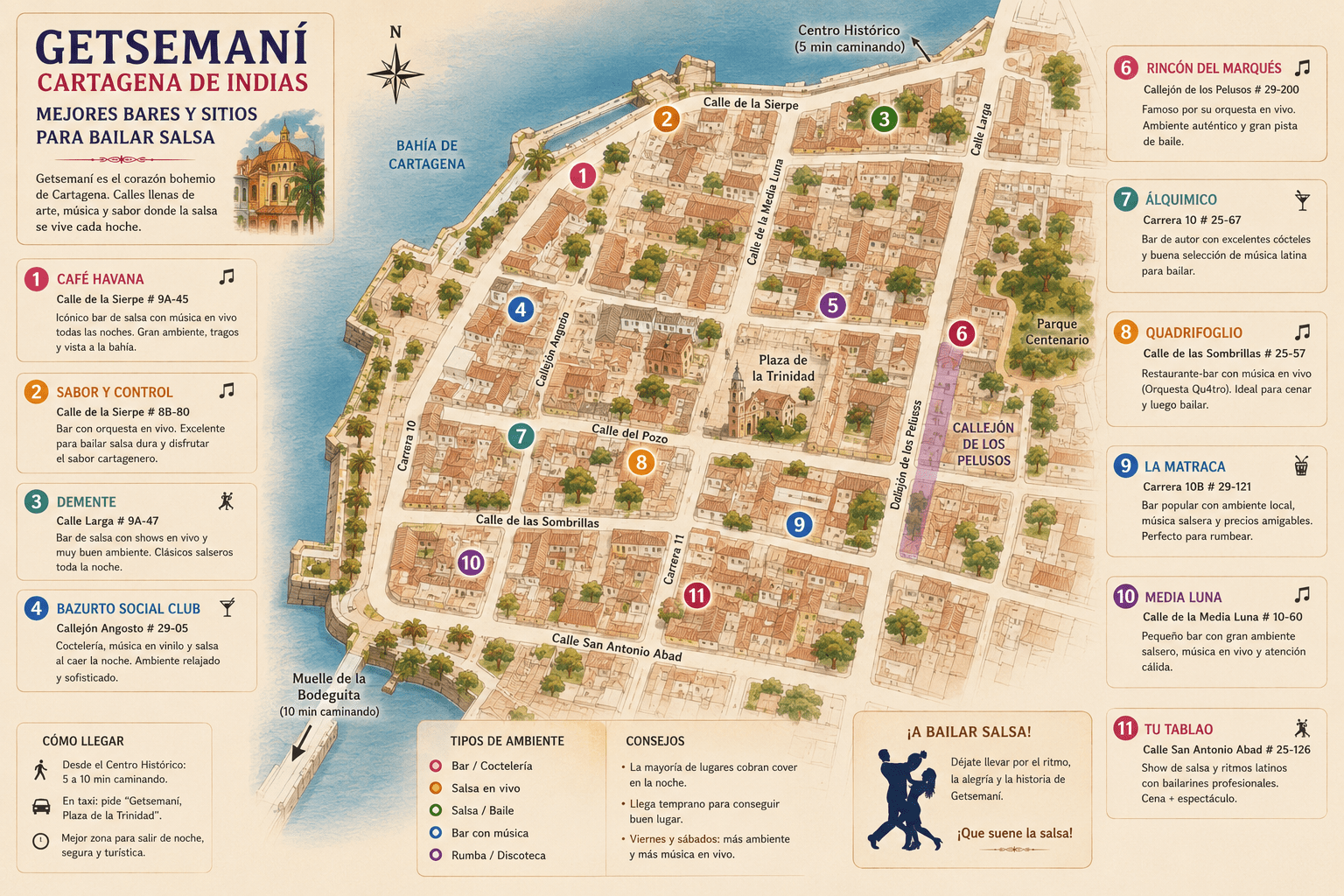
And then you can go out for drinks at any of the bars on the map above; be very careful, though, because I’ve heard horror stories about tourists who were drugged (through their drinks) by Colombian women who then fleeced them…
WHAT TO DO IN CARTAGENA DE INDIAS?: ROSARIO ISLANDS TOUR
It's the typical day trip from Cartagena de Indias; I'm not going to recommend any specific company because they all seemed a bit like rip-offs to me—I'll just give you a few highlights:
1. The program usually runs from about 8:30 a.m. to 4:00 p.m.
2. - Prices range from about 50,000 COP$ (slow boat) to 75,000 COP$ (speedboat); you can choose to be dropped off at Playa Blanca and picked up later in the day, or participate in an additional activity: the aquarium (an extra 25,000 COP$) or snorkeling (30,000 COP$).
Staying overnight in Playa Blanca is a luxury we should all experience at least once in our lives

And to wrap things up, here's a glimpse of what you'll be able to enjoy on the way there

Well, that wraps up our tour of Cartagena de Indias… If you liked this post, feel free to leave me a comment!!!
The official website of Cartagena de indias: https://www.cartagenadeindias.travel/?la=en
And if you want to know more about Colombia: https://999millas.net/category/paises/colombia/
Si te ha gustado este post o tienes alguna duda házmelo saber mediante un comentario
Texto y fotos : Mike !
 EN
EN  ES
ES