
Seul
What to do in Seoul? We have something for everyone… Two hearts beat in Seoul: the traditional and the modern, ancient customs and cutting-edge modernity… Let’s explore a little of each…
THINGS TO DO IN SEOUL: ENJOY THE TRADITIONAL SIDE
Let's split the visit between the must-see tourist spots and the hidden gems (which definitely exist—and there are quite a few of them, too ☺️)
The Insanely touristy part...
Here's an easy itinerary for enjoying Seoul's beautiful palaces, which are very well-preserved and offer guided tours

1.- Gyenongbokgung Palace
Don't let the name scare you—if you're going to ask about it, it's pronounced something like Kamboku (in my terrible Korean 😬). It means “Palace of Dazzling Fortune” or “Palace Greatly Blessed by Heaven,” but I don’t know if Heaven blessed it that much or not because it has been destroyed (and fortunately rebuilt) several times.
Its design was based strictly on the pungsu (Korean feng shui). It was built with its back to Bugaksan Mountain and facing the Han River to channel auspicious energy, and the entire complex is designed to be as harmonious as possible with the surrounding nature.
The first thing you'll see when you enter is the Palace Guard

Between 10:00 a.m. and 2:00 p.m., the changing of the guard takes place every hour amid cheers, excitement, and selfies from the local population (the guards stoically endure the barrage of photos, poses, and anything else involving a cell phone…).
What can you do in Seoul—and at this palace in particular—that’s unique and picturesque? You have the opportunity to visit it dressed in traditional Korean attire (called Hanbok), which can be rented at various prices. Be very careful when choosing the colors of your outfit because, depending on the color, you’ll be “sending a message” to Korean society:
a. Unmarried Korean women used to wear a vibrant outfit known as the Noran jeogori and Hong chima (yellow jacket and red skirt). It was a symbol of youth and readiness for marriage.
b. Newlyweds used a jeogori (jacket) green with a red skirt (Nokui Hongchima). Green symbolized fertility.
c. Married women with children wore a purple ribbon to indicate that they had a living husband, while navy blue cuffs signaled that they had a son (a status highly valued in the patriarchal society of the time).

Well, not only will you look very elegant, but you'll also get free admission to the palace if you dress like that (I'm not kidding). It ends up creating a really beautiful scene as you walk through the palace alongside people dressed in period costumes.

There are informational signs in English everywhere, and you can explore on your own. You also have the option of joining one of the free tours—also in English—that depart from the entrance; they’re quite enjoyable and last about an hour.

It’s not about boring everyone with photo after photo of the palace: in the style of Eastern palaces, it’s very harmonious, with each building in its place, following a very precise order: the king’s quarters, the queen’s, his mother’s… and those of his favorite concubine of the moment 😛
Admission costs 3,000 won, although you can buy a pass to visit these four palaces (Gyeongbokgung Palace, Changdeokgung Palace, Changgyeonggung Palace, and Deoksugung Palace), which is a better deal if you plan to see them all—the price is 10,000 won. The nearest subway stop is Gyeongbokgung (Line 3). Set aside a whole morning to see it—it’s a huge complex…
A little more information on their official website: https://royal.khs.go.kr/ENG/contents/E101010000.do
2.- Changdeokgung Palace
While the previous palace lay in ruins, the royal family took up residence in this humble dwelling (Anguk subway station, Line 3). It is the only palace in Seoul designated as a UNESCO World Heritage Site, so it’s a must-see.

The photo shows the throne room, and the mural above it illustrates the kings’ political vision at that time: if I understood correctly, the king is the sun—and the moon—which are reflected (the sun) and exert influence (the moon) on that river current flowing from the mountains (the people).
Beyond the palace (which is practically identical to the previous one), we tourists stopped by here to visit the Secret Garden, the royal family's recreational garden adjacent to the palace.

Unlike a typical construction project (where humans alter nature to adapt it to the building they intend to construct), the Korean architects behind this garden sought to alter their surroundings as little as possible and to integrate the various pavilions into the hillside as harmoniously as possible.
Be sure to note that you can’t visit on your own. You can only visit through the tour offered by the complex itself: 5,000 won, with two departure times: 10:30 a.m. and 2:30 p.m. (This ticket is separate from the one you pay to enter the palace, which costs an additional 3,000 won.) Tickets can be purchased online or at the palace ticket office. Online reservations open exactly 6 days before the visit date at 10:00 AM Korean Standard Time (KST) and sell out in minutes, especially in spring and fall. Half of the daily passes are reserved for online booking, and the other half are sold in person at the ticket office on the same day starting at 9:00 AM.
The tour itself doesn't provide much information, but the site is well worth the admission fee.

3.- Bukchon Hanok Village
But man doesn't live by palaces alone; there are other things to do in Seoul, such as wandering around the city streets
Down there we see a typical neighborhood… so what’s so special about it? Well, the residents have preserved their buildings (called hanok) just as they were in ancient times, so you can enjoy an authentic medieval town right in the heart of Seoul.

Welcome to Buchón Hanok Village. This neighborhood is home to about 900 traditional houses called hanoks, historically built with wood, stone, and clay. During the Joseon Dynasty, this area was reserved for the high nobility and senior government officials, and today these buildings are either still inhabited by private citizens or have been converted into cultural centers, etc. Here’s a suggested route for a walk through the area:
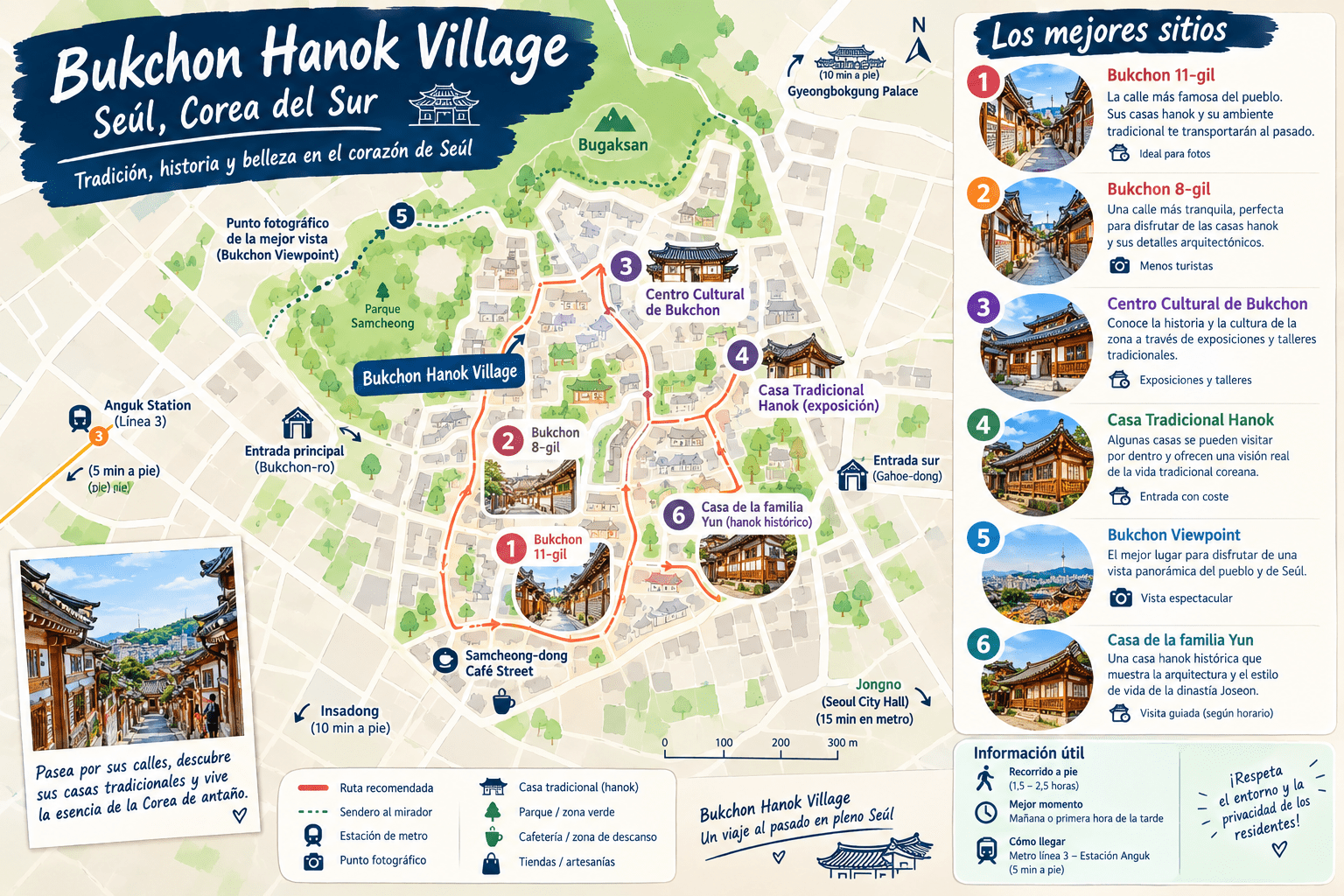
Over time—and with the influx of tourists—the area has gradually become “modernized,” and unlike the adjacent streets, all kinds of very chic shops and cafés have sprung up that are a threat to your wallet; honestly, if you want to go shopping, this isn’t the best place….
One interesting thing you’ll notice are these little figurines shown in the photo, hanging on a few houses and the subject of endless photo sessions by Asian tourists (I had to fight tooth and nail with them just to get them to let me take this one…)

Estas figuritas de madera tradicionales coreanas se llaman Kkoktu (꼭두). Aunque históricamente su función principal no era colgarse de manera permanente en las casas, sino adornar las camillas fúnebres tradicionales (sangyeo). In Korean mythology and folklore, it was believed that the soul of the deceased went through a state of confusion and fear upon leaving this world. The kkoktu se tallaban para servir como compañeros, protectores y guías en el viaje hacia el más allá y son muy variados en sus formas: soldados, cuidadores, artistas etc
WHAT TO DO IN SEOUL: THE MODERN PART OF THE CITY
Visiting its markets
Namdaemun Market
If you’re in Seoul and have a spare morning (and some money to spare), be sure to stop by this huuuuge market, which spans several city blocks; even though it’s perfectly organized by “sections” (one street for cameras, an entire building for costume jewelry, etc.), there’s nothing better than getting a little lost to see what surprises you’ll find…

If you’re not a fan of getting lost, you can pick up a map of the market at one of the tourist information booths located outside the subway station (Hoehjun, Exit 5). It’s not as touristy as the Night Market and is quite a bit cheaper, which explains the hordes of Koreans you have to dodge at every turn 😅

It's supposed to be open 24 hours a day, every day, but I stopped by one Wednesday night and it was pretty much dead 😕
Night Market and Dongdaemun Design Plaza
Seoul has set aside a space for design and artistic innovation in this plaza with its impossible curves and futuristic designs. Before it became the aluminum “spaceship” we see today, this site was home to Dongdaemun Stadium, where baseball, soccer, and other sports were played.
Today, the DDP serves as a creative and commercial hub. It is divided into main zones that host everything from Seoul Fashion Week, international contemporary art exhibitions, and design museums to talent incubation labs and markets open 24 hours a day.
So you should visit both during the day and at night.

During the day, you can immerse yourself in modern art at their design museum or visit the chicest and most sophisticated shops in all of Seoul… I’d better not mention the prices so I don’t scare people off 😬, but just stopping by—even if you don’t buy anything—is a real treat.
It's even better at night: if you're looking for something original and visually appealing, check out the Night Market—bracelets, jewelry, organic perfumes… the classic posh-hippie market, livened up with live music and a bright, futuristic skyline.
Metro lines 2, 4, and 5 run through there, so you have no excuse to miss it.

Insa – Dong Market
For anyone looking to buy a truly high-quality souvenir, I recommend stopping by this market (Anguk subway station, Line 3, Exit 6).
It's not your typical flea market where everyone sells the same thing (and to top it off, it's made in China 😓)—instead, there are little surprises in the form of shops that sell genuine handicrafts.

You can easily spend an entire morning browsing the market, have lunch there, and top it off with afternoon tea at one of its hidden, traditional-style tea houses, accompanied by the typical rice cakes (tteok).
Here is a map of the market with a simple route

Working out
What can you do in Seoul that involves a little bit of exercise?
Bike Ride Along the Hangang River.
This was one of the activities I enjoyed most in Seoul. It wasn't so much the scenery—nothing to write home about—but rather the chance to observe the everyday life of a Korean person on the weekend.
You can rent a bike at any of the stands east or west of the Yeouinaru subway station (Yeouido Park exit). It costs 3,000/5,000/7,000 won for 1 hour/2 hours/3 hours.
Once you’re on your bike, pedal along the river bike path (more than 15 km) and you’ll come across all kinds of curious scenes: Koreans set up their tents to “camp” in the most unexpected places—even though we’re right in the middle of the city—

It looks like one of those massive protests we see in the West, but no… they just set up their tents—it’s not like they’re getting dirty by sitting on the grass—and spend the day with their families: they bring their food, their kids, their mother-in-law, and, surprisingly, everything is clean and organized; you don’t see any trash on the ground or any dirt at all.

If anyone wants to follow in my footsteps, here’s an easy—and flat—route 🙂

If you want to make the route shorter than the one shown on the map, start (as I did) at Yeouido Hangang Park, where you can rent a bike, and from there you can see the coolest spots: Banpo Park and Tteokseom Park
Bukaksan
If you like hiking, this is the mountain in Seoul where dozens of Koreans, equipped with state-of-the-art gear, enjoy hiking uphill…
There’s a kind of military outpost that runs along the old city wall, and it seems to include a fortress. When I tried to go in, they asked for my passport or “alien ID card” (I guess I just look like an alien 😓), so I didn’t quite get to finish this tour…
ONE DAY TRIP: SUWON
If you have some extra time in Seoul and enjoy walking, be sure to visit the small town of Suwon—especially on the weekend.
You can get there by subway from Seoul (30–45 minutes); do NOT get off at the Suwon subway stop on Line 1. Instead, once you arrive there, continue on Line B to the Maegyo stop (Exit 6).
Why did I come all the way here? The city is home to Hwaseong Fortress, a World Heritage Site with a perfectly restored 6-km-long wall circuit featuring watchtowers and traditional pavilions every few steps; it’s a long walk up and down hills, so it’s best to come well-stocked with water…

If you're not tired after walking along the wall, it's time to visit Hwaseong Haenggung Palace. Located in the heart of the fortress, this residential palace was where the king and his court stayed when they traveled outside Seoul.
Compared to Seoul's fantastic palaces, this one might not be all that impressive, but since you're already here... why not check it out? It's quite pretty, and you can take a nice stroll around it.

As I mentioned earlier, coming here on the weekend comes with a bonus: at the Palace, the locals stage mock battles in traditional armor; it lasts about an hour, it’s free, and I recommend arriving a little early—otherwise, you won’t get a good spot.

Seoul has so much more to offer, but this post doesn't, so I'll leave it at that… still many more days in Korea…
Well, I hope I've given you some ideas for things to do in Seoul and that you found this post helpful. If so, let me know by leaving a comment!!
And if you'd like to read something about more traditional South Korea: https://999millas.net/category/paises/corea-del-sur/
Texto y fotos : Mike !
 EN
 ES