
A Stroll Through Valparaíso
How can we take a full tour of Valparaíso?
When you arrive at your hotel in Valparaíso, they'll probably give you a map of the city.
Throw it away.
No city I've ever visited invites you to get lost quite like this one. Don't let its steep hills, narrow alleys, or the unpleasant smell in the harbor area put you off. Every corner might hide a work of art, just waiting to be discovered…

So if you don't want to miss out, keep reading…
Valparaíso is divided between the port area and the many hills that surround it
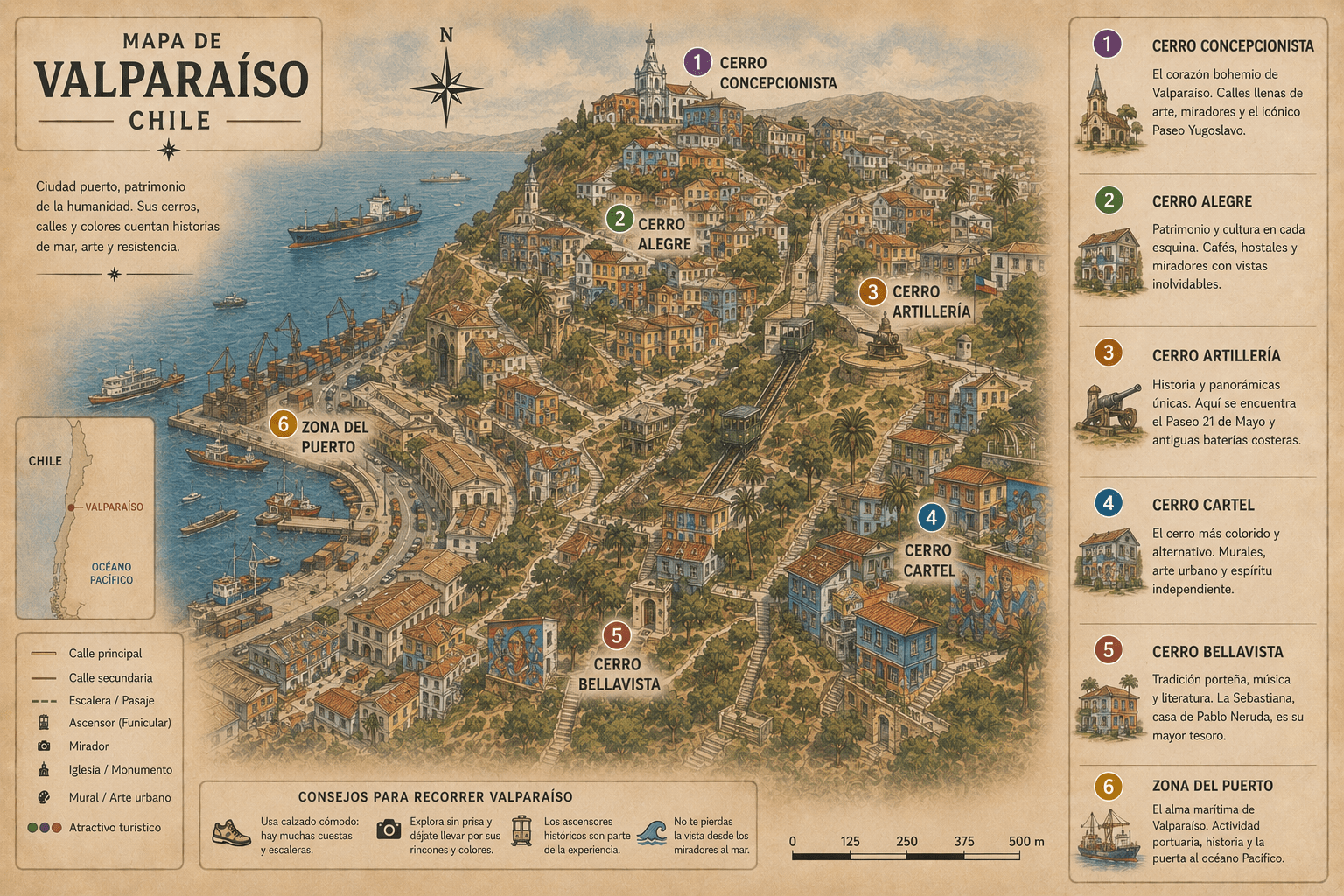
A Walk Through Valparaíso: the Concepción and Alegre Hills
They are the closest to sea level and therefore easily accessible. It would be very healthy to walk up them, but then we wouldn't get to ride the ancient elevators that transport us back to the 19th century (as well as to the top, of course).

The Reina Victoria and Concepción funiculars were built to make it easier for port workers to get from the port to their homes in the hills. The Concepción funicular takes you up to Cerro Concepción, and the Reina Victoria funicular takes you up to Cerro Alegre.
When the Concepcion Funicular was inaugurated - In 1883, many of Valparaíso's most traditional and religious residents flatly refused to go up out of fear. The creator and mastermind behind the project was Liborio Brieba, a well-known engineer who, in his spare time, wrote serialized mystery novels with spiritualist and satanic themes.
To make matters worse, during the first nighttime trips, the loud screeching of the metal wheels against the rails produced intense sparks in the darkness of the hill. The people of Buenos Aires at the time claimed, half in jest and half in earnest, that the elevator was an “invention of the devil” and that the sparks were proof that the car was taking you straight to the gates
The lightweight wooden cars, the engine rooms, the rails… even the heavy swaying that accompanies us on the climb seems to have been meticulously preserved. And no, it doesn’t take you to hell or anything.

Okay, let's start our tour of Valparaíso. Once we reach the top, we find a very unique neighborhood, taken over by a legion of graffiti artists and other artists determined to surprise us at every turn, at every moment… there isn't a single brick wall here that hasn't been covered in paint.

One of the main attractions of both hills is the Templeman Street, the main street that runs north to south through the hill. I'm not going to spoil the surprise by posting photos of the street; I'll just give you a sense of the philosophy behind it

Wisely, the neighborhood offers no guidance on what to see, what to do, where to sit, or where to stay… I could suggest you visit the Museum of Fine Arts or the Lukas Cartoon Museum, but I’ll pass… You just have to enjoy yourself and take part in the show… Is it real or staged? Does it even matter?

Anyone who wants to enjoy a proper sunset in Valparaíso can head to the many bars with elevated terraces located right outside the Reina Victoria elevator, or have a hot chocolate at the small cafés next to the Atkinson Promenade.
Cerro Artillería
The second hill on our walk through Valparaíso. Hang in there—we still have a ways to go…
Since this is home to the military, we’d expect a little more seriousness… It’s true that the atmosphere isn’t as wild as it is at the port or as poetic as it is on other hills, but some of the city’s characteristic fun still seeps through.

Seriously though, at the top there's the Naval Museum and a lookout overlooking the bay, which is actually kind of ugly….
Cerro Carcel
This one's pretty high up, and there's no elevator 😱
Que no cunda el pánico.
El autobus 612 te lleva por esas alturas desde la zona del puerto. La plaza de este cerro (Pza Bismarck) ofrece buenas vistas a la bahía; bajando un poco llegas al Parque Cultural, lo que era la carcel donde Pinochet encerraba a los prisioneros políticos , felizmente reconvertido a un centro cultural abierto a todos.
Cerro Bellavista
El hermano rebelde de Cerro Alegre. Sucio, salvaje y desarreglado pero….es el inicio de todo esto.
The origin of the murals in the Cerro Bellavista is directly linked to the birth of the Museo a Cielo Abierto de Valparaíso (MaCA) And so a group of student artists set out to beautify this part of the city by painting murals in the most unexpected places; there are about 20 of them, scattered haphazardly all over the hill (fortunately 😊); the dictatorship put an end to this project….

During the major painting phase in the early 1990s, established artists (who were already elderly or living outside Chile) sent their sketches and scale drawings to Valparaíso. The ones who actually climbed the scaffolding to trace the lines and fill in the colors under the Valparaíso sun were art students from the university and the hill’s own residents.
This led to some very funny situations:
The official artists almost never showed up on the hill. When Bellavista’s oldest residents saw a group of unfamiliar young people painting giant, strange, colorful abstract figures on the walls of their homes, they thought they were nighttime vandals or “crazy graffiti artists” ruining the neighborhood in the early morning hours.
On more than one occasion, residents went out onto their balconies to yell at them, throw water at them, and even called the police so they would arrest the students….poor students, martyrs for their art 🙂
There aren't any expensive restaurants here. Everything is pretty dirty. There are hardly any tourists. It's the perfect opportunity to wander the streets and discover its hidden corners—like the Pasaje de Santa Lucía– and gossip with the neighbors

While art at Cerro Alegre has been tamed, sanitized, and made tourist-friendly, here it appears neglected, untamed, and left to fend for itself… a completely different experience from Cerro Alegre

The mother of all hills starts at this hill—C/ Ferrari—and takes us to La Sebastiana, Pablo Neruda’s home, which has now been converted into a museum.
It is nestled on a ledge on the hillside, and it's worth paying the 6,000 CH$ to visit it because it is a monument to good taste and still features the poet's original furniture and workspace.

These were the views from his bedroom, a veritable eagle's nest overlooking the city.
A little more information about Neruda's House: https://fundacionneruda.org/museos/casa-museo-la-sebastiana/
Port Area
This is the natural habitat of the city's alternative types and hippies. I wouldn't say the area is more aggressive than the rest of the city, but it is certainly much more rebellious.

By the way, along the stretch between Plaza Sotomayor and Plaza Wheelwright, there are plenty of seafood restaurants, and they’re very cheap compared to prices in tourist areas; at the harbor, there are also “boats” that will take you on a tour of the bay for 3,000 CH$.
Night falls.
A horde of street performers with their juggling props, guitars, and bicycles… gather in Plaza del Deseo (between Cumming and Atahualpa streets) to rehearse their acts. There’s applause, cheering, lots of beer… an incredible atmosphere
On this street (Cumming) and the parallel streets leading uphill are the most daring bars, each one more unique than the next… and each one competes with the others to catch your camera’s eye; some of the facades are stunning.
And that wraps up our tour of Valparaíso… I invite everyone to come here and experience—literally—the magical atmosphere that surrounds this city

If you want to read more about Chile: https://999millas.net/category/paises/chile/
Or visit their official website: https://valpoturistico.cl
And, as always, whether you loved or hated this post, let me know in the comments!! 🙂
Texto y fotos : Mike ¡
 EN
 ES